The University of the Virgin Islands announces the winners of the 6th annual Hackathon,
which was held on both the St. Thomas and Albert A. Sheen Campuses on October 18 and
19, and October 25 and 26, respectively.
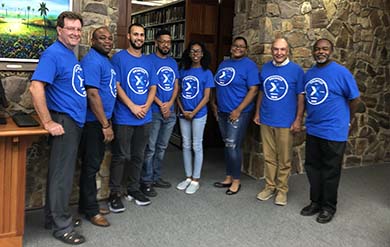
The marathon app concept development competition was keenly contested by 12 students,
four on the St. Thomas Campus and eight on the Albert A. Sheen Campus. Addressing
the themed hack – “Power,” the five student-teams identified and created solution
concepts to fix frustrations related to power in the Virgin Islands community.
Consistent with the tradition, on the final day, the students presented their app
concepts before a panel of judges who determined the Best Hack, Most Creative Hack
and Most Impactful Hack.
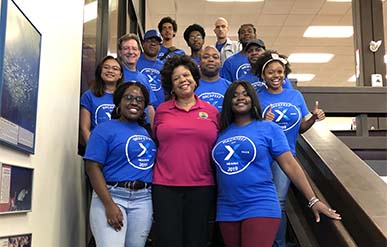
Albert A. Sheen Campus Participants with Dean of the School of Business, Judges
and Coaches
The Best Hack on the Albert A. Sheen Campus was designed by a four-person team including
Kedisha Charles, Javier Galiber, Renell Agard and Kelvina Salters. The team dubbed
“Power Bucs”, through their app –“UPower,” devises a way to monitor the amount of
electricity one consumes. In addition to self-monitoring, it allows one to remotely
turn-off the power to home appliances or set them on a timer.
Salters stated that her team was inspired to solve a problem that “came close to home”
for the average Virgin Islander, as it relates to power. “After brainstorming, we
agreed that the inconsistencies of power supply and the inflated costs needed a solution-based
approach,” she said. “In light of this, our brainchild UPower was born. The app provides
a user-friendly roadmap on how the average consumer can monitor and control power
usage per kilowatts and affords them the privilege of negotiating discrepancies associated
with their bills."
“Our team's participation in this year's Hack fest was inspired by each individual's
desire to challenge their problem-solving, analytical and technical skills,” said
Salters. “While assembling the team, we realized that the diversity in our disciplines
and expertise would be beneficial in creating an innovative app. Therefore, we capitalized
on the strengths that each individual brought to achieve this.”
The Best Hack on the St. Thomas Campus was created by a duo-team comprising Rysa Bryan
and Ahmad Abdul-Samad. Their app, “VI-BER,” empowers individuals to help others. According
to the team, VI-BER creates the “Uber of donations.”
“VI-BER is basically a platform in which persons wanting to donate clothing items
would be able to schedule an appointment for a driver to come and pick up the clothes
from the location of their choosing,” said Bryan. The driver would then take it to
a specific shelter, based on the description of the items given and who needs it the
most,” she said. “I came up with this idea by drawing inspiration from my family’s
issue of all ways saying that we are going to stop by the Salvation Army but we never
have the time to actually stop. Then, the clothes just sits there while other people
that need them are not getting the resources that they need. When created VI-BER,
will impact many lives.”
“Our team’s participation in the competition came about from our love of business
challenges,” said Bryan. “As soon as I saw the flyer for the hackathon, I knew that
I had to be there and I had to come up with an idea that would blow away the judges,”
she added. Bryan said that her teammate, Abdul-Samad was instrumental in the overall
completion of the idea. “He helped me add new concepts and design ideas that bettered
the app to take the winning prize.”
The Most Impactful app on the Albert A. Sheen Campus was dubbed “UVIBES 340.” The
app was designed by Anthony Laurent and Milan Philbert. UVIBES 340 creates a local
social media hub, combining aspects of YouTube, Facebook and other similar platforms
but focuses exclusively on people and activities occurring in the Territory.
The Most Impactful app on the St. Thomas Campus - “Localize,” was designed by Brandon
Jospeh and Akima Richardson. The app seeks to empower people to advance their careers.
“Localize” creates a “local LinkedIn” so that individuals can find and network with
local professionals in the Virgin Islands.
The Most Creative app was selected from the Albert A. Sheen Campus. The “Circuit Hub,”
created by Rex Calzaubon III and Amaia Nicole Saret, allows one to monitor power consumption
in one’s home and turn on and off entire circuits remotely.
“Congratulations to all the students who worked hard to create and present their phone
app concepts,” said Dr. Timothy Faley, Hackathon director and Sokoloff professor of
Entrepreneurship.
This year’s event witnessed a prize increase thanks to the philanthropic deed of a
longstanding sponsor of the competition, Leon Hughes, founder and CEO of Nearix -
a St. Croix software development firm.
The winning teams of the Best Hack award will receive a monetary prize of $500. While
the winning teams of the Most Impactful and Most Creative apps will receive $250 each.
These awards will be presented at the annual awards luncheon gala in Spring 2020.
This initiative was made possible through the sponsorship of Nearix. Other support
came from UVIDEA club, the School of Business and faculty and staff across the University.
“The two hackathons would not be possible without the support and enthusiasm of Leon
Hughes,” said Dr. Faley. “Thank-you Mr. Hughes,” he said emphatically. “Thanks to
the judges and coaches that participated: Dr. Kendra Harris, dean of the School of
Business, Dr. Marc Boumedine, department chair and professor of Computer Science,
Dr. Glenn Metts, professor of Management and Entrepreneurship, Dr. Renel Smith, Smith,
assistant professor of Computer Information Systems, and Elroy Richard, librarian.”
For more information about Hackathon, contact the Public Relations Office at (340)
693-1059 or email pr@uvi.edu.