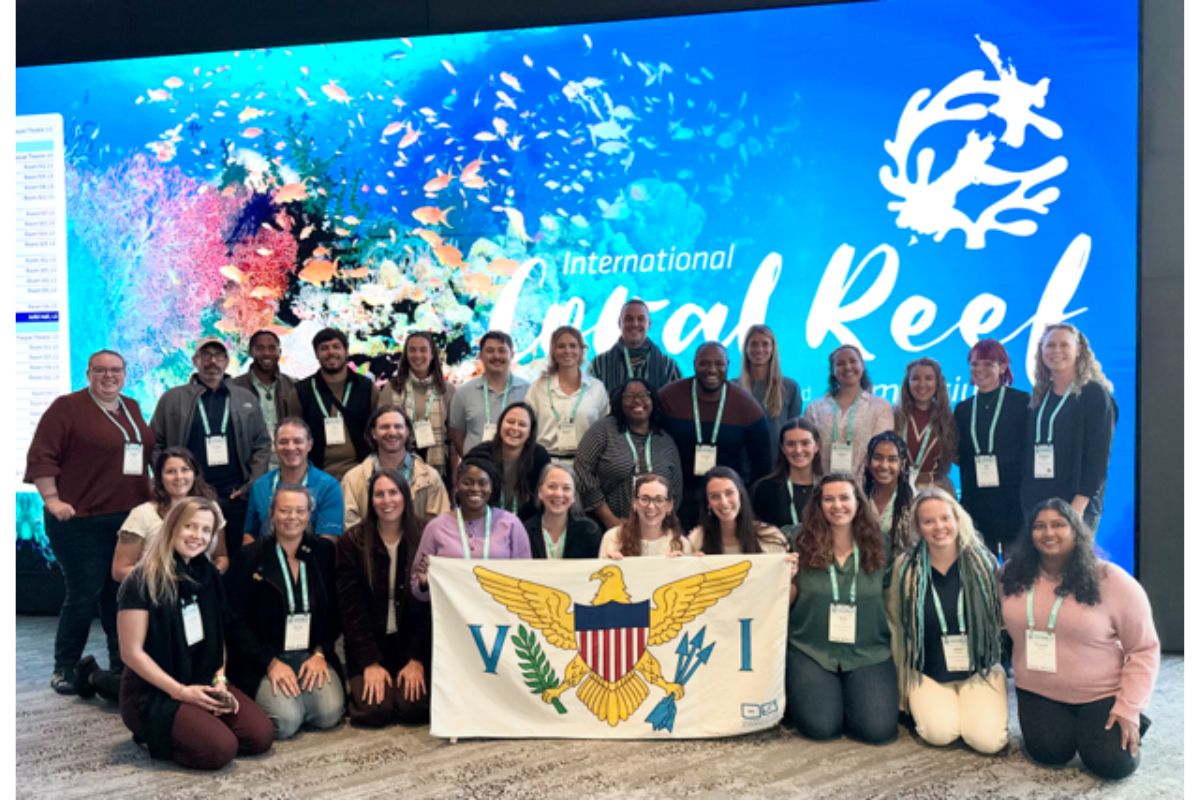
Twenty-three-member delegation showcases UVI research through 26 presentations in New Zealand
The University of the Virgin Islands reinforced its growing influence in global marine science as 23 researchers and students from UVI’s Center for Marine and Environmental Studies (CMES) delivered 26 presentations at the 16th International Coral Reef Symposium, held this summer, in Auckland, New Zealand.
The symposium, held every four years, is the world’s largest scientific gathering dedicated to coral reef research. This year’s event attracted more than 2,100 scientists from 90 countries.
Despite being one of the smallest institutions represented by enrollment, UVI ranked among the top 10 universities for the number of presentations delivered—placing it alongside major research institutions more than 10 times its size.
UVI-led research presented at the symposium included contributions from 86 collaborators representing 43 institutions. Current and former UVI researchers were also listed as authors on 64 presentations, demonstrating the reach, productivity and global impact of the University’s marine science programs.
“Our researchers and students brought the story of the U.S. Virgin Islands’ coral reefs to the world,” said Dr. Tyler Smith, interim director of CMES, who traveled with the delegation. “It was a privilege to accompany this talented group as they showcased the important work being conducted across the territory. Seeing UVI’s impact on coral reef science at the global level was awe-inspiring and reflects the success of sustained efforts to expand scientific research, education and capacity in the Virgin Islands.”
UVI researchers shared critical findings about the condition of the territory’s internationally recognized coral reefs and the work underway to monitor, protect and restore coral and coastal ecosystems. Their presentations addressed the unprecedented marine heat waves and mass coral bleaching events of 2023 and 2024; treatment of stony coral tissue loss disease and efforts to understand its causes and spread; mesophotic reefs; coral restoration and gene banking; mangrove recovery following two Category 5 hurricanes; community stewardship amid coastal change; and the use of artificial intelligence and robotics to advance marine research and education.
Travel for the UVI delegation was funded entirely through competitively awarded research grants and charitable contributions. The Virgin Islands Center for Autonomous Research (VICAR), supported by a $7 million National Science Foundation grant, funded travel for 13 UVI researchers and students. The Lana Vento Charitable Trust also provided significant support for the delegation.
The strength of UVI’s Master of Marine and Environmental Science (MMES) program was evident throughout the conference. Nineteen members of the 23-person delegation have ties to the program, including six current graduate students and 13 alumni who now serve as CMES specialists, technicians and faculty members. The MMES program has graduated 155 students since 2008.
UVI’s influence extended beyond the official delegation. Nine former UVI researchers delivered an additional 11 presentations, including seven MMES graduates. They now hold professional positions or are pursuing advanced degrees at Pennsylvania State University, the University of Technology Sydney, the University of Puerto Rico at Mayagüez, Arizona State University, Florida Atlantic University, the National Oceanic and Atmospheric Administration’s National Coral Reef Monitoring Program, and the Virgin Islands Department of Planning and Natural Resources.
The University’s strong showing at the symposium highlights UVI’s role in developing the next generation of marine scientists while producing research with direct relevance to the environmental resilience and long-term sustainability of the U.S. Virgin Islands and the wider Caribbean.
Established in 1999, the University of the Virgin Islands’ Center for Marine and Environmental Studies (CMES) is a hub for marine research, education and conservation in the U.S. Virgin Islands and the wider Caribbean. CMES administers UVI’s Master of Marine and Environmental Science program and leads research addressing coral reef health, fisheries, coastal ecosystems, climate impacts and marine-resource management. Through long-term environmental monitoring, student training and collaboration with local, national and international partners, the Center produces science that informs conservation, strengthens environmental resilience and prepares the next generation of marine professionals.