Student Learning Outcome Assessment

This website is designed to inform faculty, students, university personnel and community members on the assessment of student learning. Additionally, this website will provide information resources to assist UVI academic units in developing unit assessment plans. By working together, while maintaining our focus on UVI's mission, our faculty, staff and administration will: develop and implement assessment plans; use assessment results to inform curricular and instructional improvements; and deploy these improvements to enhance student learning and success.

Committee Mission/Purpose:

Meeting Time & Location:

Committee Members:

  • CLASS consists of Division Assessment Coordinators, administrators, and students. Administrators come from key functions that enable or support student learning and contribute a critical input to CLASS to enhance decision-making quality and effectiveness. Students provide the perspective of the customers we aim to serve and, likewise provide unique and important input to CLASS. Each Division Coordinator has overall responsibility to lead the assessment planning and implementation activities and processes within their Division. Specifically, Division Coordinators perform the following duties:

    • Attend and actively participate in scheduled meetings of CLASS;
    • Maintain a focus within the division on student learning and assessment;
    • Promote, in collaboration with the division chair, discussions and monitor subsequent actions on the use of assessment data in facilitating student learning;
    • Oversee the identification of courses to be assessed;
    • Ensure that appropriate student learning growth plans are in place;
    • Lead the development of assessment reports from the division for the Provost; and
    • Submit reports on assessment, as required.

Long-Term Goals:

Long-term goal is to spearhead UVI's transformation into a 'culture of evidence' and a learner-centered institution committed to student success. To specifically impact the culture change, Office of Student Learning Outcomes Assessment must achieve several related strategic objectives.

The University of the Virgin Islands' journey to effectively institute student learning outcomes assessment has been and will continue to be an evolutionary 'organizational learning process', rather than a "big bang" transformation done right the first time. The University realizes that "assessment is a learner-centered movement and plays a key role in shifting from a teacher-centered to a learner-centered paradigm by forcing us to ask, 'What have our students learned and how well have they learned it?' 'How successful have we been at what we are trying to accomplish?'"

To be successful UVI's student learning assessment program requires:

  1. full faculty and Division Chair engagement;
  2. emphasis on the use of assessment results to inform decisions such as academic planning and program improvement; curriculum reform; instructional methods improvements, policy changes and resource allocation;

Therefore, realizing the importance of being learner-centered, UVI's student learning assessment program is driven by the University's VISION 2012 mission and related goals of educational excellence and institutional improvement:

Mission Statement - The University of the Virgin Islands is a learner-centered institution dedicated to the success of its students and committed to enhancing the lives of the people of the U.S. Virgin Islands and the wider Caribbean through excellent teaching, innovative research and responsive community service.

VISION 2012 Goal #1 - Educational Excellence - Create a learner-centered experience that fosters academic excellence and student success through innovative, effective teaching strategies and high quality academic and student support programs.

VISION 2012 Goal #2 - Institutional Improvement - Insure that the strategic goals and objectives are met by enhancing the capacity of the University to achieve results.

Sources:
  • Nichols, J. O. (2005). A Road Map for Improvement of Student Learning and Support Services Through Assessment, New York Agathon Press.
  • Huba and Freed (2000). Learner-Centered Assessment on College Campuses. Needham Heights, MA, Allyn and Bacon
  • Why assess at UVI? The University of the Virgin Islands' journey to effectively institute student learning outcomes assessment has been and will continue to be an evolutionary 'organizational learning process', rather than a "big bang" transformation done right the first time . The University realizes that "assessment is a learner-centered movement and plays a key role in shifting from a teacher-centered to a learner-centered paradigm by forcing us to ask, 'What have our students learned and how well have they learned it?' 'How successful have we been at what we are trying to accomplish?' ' Are we making a difference?' "

  • What is assessment? Assessment is the process of gathering and discussing information from multiple and diverse sources in order to determine whether or not intended academic outcomes or administrative objectives have been achieved and to what extent these have been achieved.

  • What do I do with the assessment data my program has collected? The 'Use of Data' is in the final step of the assessment process. Therefore, once the assessment data has been collected, analyzed and interpreted, decisions should be made about what to do about the results. Such decisions should lead to specific and documented action steps implemented to improve the quality of the academic program assessed or improve the assessment processes and methods used.

  • What is Student Learning Outcomes Assessment? While external pressures from government funding entities and regional accrediting bodies have intensified the level of attention given to and focus on outcomes assessment, the primary purpose for UVI doing student learning outcomes assessment is for improving student learning. Therefore, UVI defines student learning outcomes assessment as a faculty-driven process that systematically gathers, interprets, and uses data for the purpose of improving student learning.

  • Who is Responsible for Student Learning Outcomes Assessment at UVI? The Director, in collaboration with the Division Coordinators, oversees the production of summary reports of each Division's assessment of student learning (e.g. for re-accreditation and other such reporting). The Director of Student Learning Outcomes Assessment chairs CLASS. Currently, CLASS comprises the following members:
    • Director of Student Learning Outcomes Assessment, Chairs
    • Division Assessment Coordinators o General Education Assessment Coordinator
    • Director of Counseling and Placement
    • Representative from Office of Institutional Research
    • Additional UVI faculty, administrators and students to be added soon.

    Within each academic division, CLASS Division Coordinators will function as the links between the university-wide student learning outcomes assessment activities and their division's assessment planning and implementation processes. CLASS Division Coordinators work with their respective Division faculty members and Chairs to develop and implement the assessment of Division academic programs. Each Division Coordinator has the following responsibilities:

    • Attend and actively participate in scheduled meetings of CLASS;
    • Maintain a focus within the division on student learning and assessment;
    • Promote, in collaboration with the division chair, discussions and monitor subsequent actions on the use of assessment data in facilitating student learning;
    • Oversee the identification of courses to be assessed;
    • Ensure that appropriate student learning growth plans are in place;
    • Lead the development of assessment reports from the division for the Provost; and
    • Submit reports on assessment, as required.

  • Why can't we just use grades as course or program assessments? Grades are not regarded as a valid and direct assessment measure of performance. However, the set of multiple performance criteria faculty often use to determine a grade can be used as assessment of performance. For example, a professor might give a student an overall grade of 'B' for their oral presentation of a topic. The criteria the professor might use to evaluate, on a scale from 0 to 5, the oral presentation might includes:
    1. to what extent the student maintained eye contact;
    2. the extent to which the student spoke fluently;
    3. the extent to which the student used hand gestures and body movements appropriately; and
    4. the quality of standard English language usage.

    The scores, from 0 to 5, a student receives on each of these 4 criteria represent assessment of measures of performance.


  • How do faculty benefit from assessment information? Assessment information can help us answer:
    • How well do actual student outcomes match our expected learning outcomes, objectives and goals?
    • To what extent does our curriculum comply with our mission statement?
    • Are students learning what they are suppose to learn?
    • What impact is UVI having on its students and how do we know?

  • Is there a step-by-step guide for the assessment process? UVI will perform student learning outcomes assessment at the program level for both the general education program and academic Division degree programs. Each academic Division is responsible for developing and implementing a student learning outcomes assessment plan and process. The assessment process involves five steps:
    1. Identify Institutional Mission Statement and Institutional Goals;
    2. Develop Academic Program Learning Outcomes;
    3. Develop Means of Assessment and Criteria for Success;
    4. Collect and Analyze Assessment Data and
    5. Interpret, Use and Report Assessment Results.
    This assessment approach, called the Nichols Five Column Model, is well-established in the assessment industry and is accepted by both accreditation bodies and funding agencies. The University's approach to student learning outcomes assessment is based upon industry best practices and consists of this five step cycle.


  • What resources are available to assist faculty? We have a list of various assessment resources available on our website.

The Office of Student Learning Assessment (OSLA) provides resources, advocacy, training and consulting services to academic Divisions to facilitate the development and implementation of adaptive, responsive, faculty-led student learning outcomes assessment plans, processes and practices that uses assessment results to continuously improve academic programs and achieve student success.

OSLA's Long Term Goal and Objectives

OSLA's long-term goal is to spearhead UVI's transformation into a culture of evidence' and a learner-centered institution committed to student success. To specifically impact the culture change, OSLA must achieve several related strategic objectives:

OSLA's Strategic Objectives

Given UVI's current state among faculty, administration, staff and community, five key strategic objectives are important and relevant to transforming UVI into a culture of evidence' and a learner-centered institution committed to student success:

  1. Encourage dialogue, raise consciousness, build consensus and establish an authentic learning community based upon greater trust, higher quality communication and more inclusive decision-making practices;
  2. Reframe the thinking and approaches towards learning outcomes assessment from an end-of-term reporting ritual to an ongoing process of continuous reflection, organizational learning and improvement;
  3. Approach student learning as a comprehensive, holistic, transformative activity that integrates in-class academic learning and out-of-classroom student development and learning experiences;
  4. Make better use of UVI's current technology, systems and data and identify additional enabling technology available in the marketplace;
  5. Better structure and align UVI's educational architecture and curriculum such that is operates to place learning first in every policy, program and practice.

Nichols, J. O. (2005). A Road Map for Improvement of Student Learning and Support Services Through Assessment, New York, Agathon Press.

Student Learning Outcomes Assessment Characteristics to be Achieved by 2012

UVI's assessment initiative will achieve strategic alignment with Vision 2012. The section below lists these ambitious milestones to be achieved by 2012. For universities early in their evolution of implementation of assessment culture of evidence, the Higher Learning Commission (HLC) of North Central Association(NCA) provides a set of attributes characteristic of more advanced development. The HLC's list of served as a useful guide for the specification of the following characteristics UVI will strive to attained by 2012.

By UVI's 50th Anniversary in 2012:

  1. Assessment will become an institutional priority and a way of life;
  2. Students, faculty, and staff will view assessment activities as a part of the institution's culture and as a resource and tool to be used in improving student learning at all degree and program levels;
  3. Faculty and Administration will understand and value the purposes, advantages, and limitations of assessment ;
  4. All academic degree programs will have devised and implement assessment plans;
  5. Each assessment plan devised will specify learning or program outcomes, measures and criteria for success and changes made as result of using the data;
  6. Assessment of general education skills, competencies, and capacities will be fully implemented;
  7. Faculty, administrators and staff at UVI will realize that assessment efforts are for improving student learning;
  8. Led by Division Chairs (Deans), UVI faculty in many or most departments will have developed measurable objectives for each of the program's educational goals;
  9. Led by Chairs (Deans), UVI faculty members will actively ensure that direct and indirect measures of student learning are aligned with the program's educational goals and measurable objectives;
  10. Led by Division Chairs (Deans), faculty will be actively involved in interpreting the assessment results and recommending improvements based upon these results (i.e., "closing the loop");
  11. The UVI Faculty Governing Body, Assessment Committee, Curriculum Committee, other faculty bodies, and individual faculty leaders will all be committed to becoming knowledgeable and remaining current in the field of assessment;
  12. There will be student representation on the university-wide assessment committees and on all Divisional (School) assessment committees;
  13. UVI will routinely and effectively communicate to students the purposes of assessment efforts and their roles in these efforts, beginning with the Freshman Orientation Program and continually until they graduate;
  14. The Provost and Chief Academic Officer will annually negotiate a budget for the assessment program that is enough for the technological support, physical facilities, and space needed to sustain a viable assessment program and to make professional development opportunities available;
  15. Chairs will use Divisional funds for faculty professional development, faculty release time and other expenses associated with the Division's assessment activities and initiatives that are determined by the Division's assessment findings aimed at improving student learning;
  16. UVI will provide Chairs (Deans) with resources to fund their improvement needs identified from use of assessment results;
  17. Assessment information sources such as an assessment newsletter and/or an assessment resource manual will be available to faculty to provide them with key assessment principles, concepts, models, and procedures;
  18. All Divisions and the Curriculum Committee will require that faculty members indicate on the syllabi of previously approved courses and in the proposal for new courses, and for new or revised programs, the measurable objectives for student learning and how student learning will be assessed;
  19. Considerable program-level data about student and program performance will be available and "
  20. Assessment data will be consistently used as the basis for making changes across the institution;
  21. Assessment findings about the state of student learning will be incorporated into reviews of the academic program and into the self-study of institutional effectiveness.
  22. The conclusions faculty reach after reviewing the assessment results and the recommendations that they make regarding proposed changes in teaching methods, curriculum, course content, instructional resources, and in academic support services will be incorporated into regular Divisional and institutional planning and budgeting processes and will be included in the determination of the priorities for funding and implementation;
  23. Assessments of student learning will be conducted from at each transition point from the students' entry to exit: Admissions; Developmental Skills; General Education; Degree Programs; Career Placement; Alumni/Stakeholder Relations (see the "Assessment Spider" below).

Source:

Higher Learning Commission NCA (2003). Restructured Expectations: A Transitional Workbook. "Assessment of Student Academic Achievement: Assessment Culture Matrix" Higher Learning Commission of the North Central Association of Colleges and Schools

Sample Student Learning Outcomes Assessment Forms

  • Title Page (Form A, list of degree programs)
  • Linkage Page (Form B, list of intended outcomes)
  • Outcome Report (Form C, first criteria for success, data, and results)
  • Outcome Report (Form C, second criteria for success, data, and results)

Note: If further means of assessment is required, use Form C again and label it as "Third Means of Assessment for Outcome Identified Above"

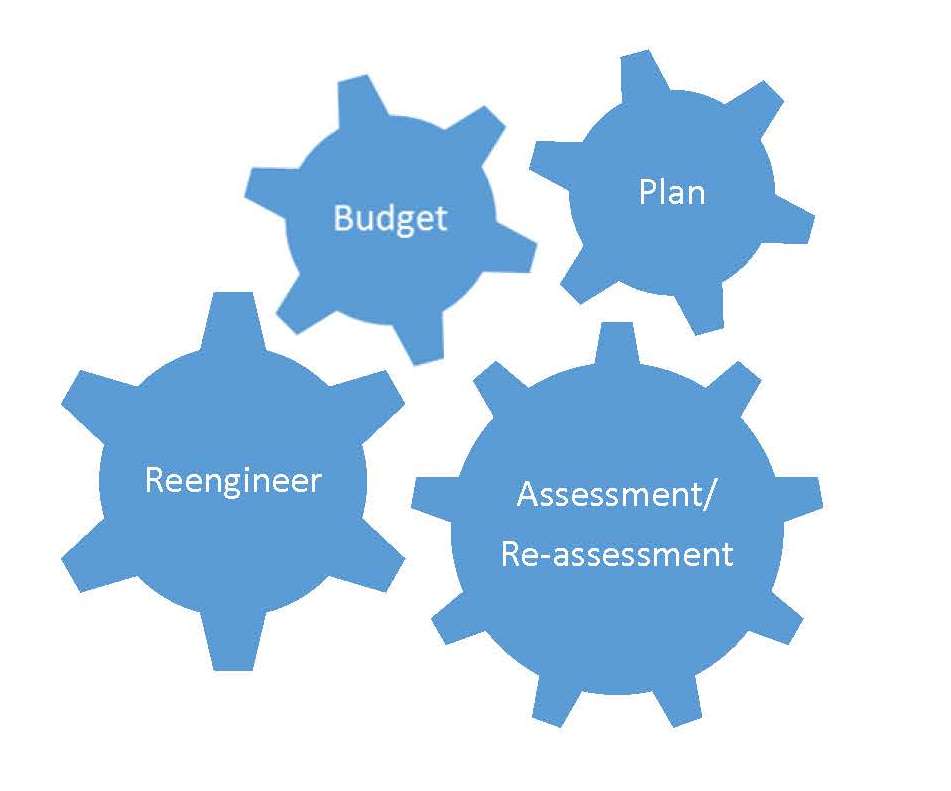
Each UVI academic unit follows the University's approach to outcomes assessment consisting of the following five step cycle:

Steps of the Assessment Process

  1. Identify Institutional Mission Statement and Institutional Goals;
  2. Develop Academic Program Learning Outcomes;
  3. Develop Means of Assessment and Criteria for Success;
  4. Collect and Analyze Assessment Data and
  5. Interpret, Use and Report Assessment Results.
 

The 5 Step assessment approach we are using assures that specific reactions and actions occur with respect to the assessment results reported. Once the fifth step in the process, i.e., the Use of Results, is completed and documented, then the assessment report is filed. The Use of Results, and related discussions, decision-making and actions, occur within the respective academic divisions.

Source:

  • Nichols, J. O. (2005). A Road Map for Improvement of Student Learning and Support Services Through Assessment, New York, Agathon Press.

Student Learning Outcomes Assessment Characteristics to be Achieved by 2012

UVI's assessment initiative will achieve strategic alignment with Vision 2012. The section below lists these ambitious milestones to be achieved by 2012. For universities early in their evolution of implementation of assessment culture of evidence, the Higher Learning Commission (HLC) of North Central Association(NCA) provides a set of attributes characteristic of more advanced development. The HLC's list of served as a useful guide for the specification of the following characteristics UVI will strive to attained by 2012.

By UVI's 50th Anniversary in 2012:

  1. Assessment will become an institutional priority and a way of life;
  2. Students, faculty, and staff will view assessment activities as a part of the institution's culture and as a resource and tool to be used in improving student learning at all degree and program levels;
  3. Faculty and Administration will understand and value the purposes, advantages, and limitations of assessment ;
  4. All academic degree programs will have devised and implement assessment plans;
  5. Each assessment plan devised will specify learning or program outcomes, measures and criteria for success and changes made as result of using the data;
  6. Assessment of general education skills, competencies, and capacities will be fully implemented;
  7. Faculty, administrators and staff at UVI will realize that assessment efforts are for improving student learning;
  8. Led by Division Chairs (Deans), UVI faculty in many or most departments will have developed measurable objectives for each of the program's educational goals;
  9. Led by Chairs (Deans), UVI faculty members will actively ensure that direct and indirect measures of student learning are aligned with the program's educational goals and measurable objectives;
  10. Led by Division Chairs (Deans), faculty will be actively involved in interpreting the assessment results and recommending improvements based upon these results (i.e., "closing the loop");
  11. The UVI Faculty Governing Body, Assessment Committee, Curriculum Committee, other faculty bodies, and individual faculty leaders will all be committed to becoming knowledgeable and remaining current in the field of assessment;
  12. There will be student representation on the university-wide assessment committees and on all Divisional (School) assessment committees;
  13. UVI will routinely and effectively communicate to students the purposes of assessment efforts and their roles in these efforts, beginning with the Freshman Orientation Program and continually until they graduate;
  14. The Provost and Chief Academic Officer will annually negotiate a budget for the assessment program that is enough for the technological support, physical facilities, and space needed to sustain a viable assessment program and to make professional development opportunities available;
  15. Chairs will use Divisional funds for faculty professional development, faculty release time and other expenses associated with the Division's assessment activities and initiatives that are determined by the Division's assessment findings aimed at improving student learning;
  16. UVI will provide Chairs (Deans) with resources to fund their improvement needs identified from use of assessment results;
  17. Assessment information sources such as an assessment newsletter and/or an assessment resource manual will be available to faculty to provide them with key assessment principles, concepts, models, and procedures;
  18. All Divisions and the Curriculum Committee will require that faculty members indicate on the syllabi of previously approved courses and in the proposal for new courses, and for new or revised programs, the measurable objectives for student learning and how student learning will be assessed;
  19. Considerable program-level data about student and program performance will be available and "
  20. Assessment data will be consistently used as the basis for making changes across the institution;
  21. Assessment findings about the state of student learning will be incorporated into reviews of the academic program and into the self-study of institutional effectiveness.
  22. The conclusions faculty reach after reviewing the assessment results and the recommendations that they make regarding proposed changes in teaching methods, curriculum, course content, instructional resources, and in academic support services will be incorporated into regular Divisional and institutional planning and budgeting processes and will be included in the determination of the priorities for funding and implementation;
  23. Assessments of student learning will be conducted from at each transition point from the students' entry to exit: Admissions; Developmental Skills; General Education; Degree Programs; Career Placement; Alumni/Stakeholder Relations.

    Source:

Higher Learning Commission NCA (2003). Restructured Expectations: A Transitional Workbook. "Assessment of Student Academic Achievement: Assessment Culture Matrix" Higher Learning Commission of the North Central Association of Colleges and Schools.